
Most doctors preparing to work abroad focus on exams, visas, contracts, and relocation logistics. I did the same. I believed that once I secured a job overseas, the hardest part would be over. That belief was one of my first mistakes.
In reality, the first year abroad is not where doctors fail clinically—it is where they quietly make mistakes they don’t even recognize at the time. These errors are rarely dramatic. They don’t show up in incident reports or exam scores. Instead, they accumulate slowly, affecting confidence, performance, health, and identity.
This article is not written from hindsight perfection. It is written from lived experience—after recognizing the mistakes that cost me time, energy, and unnecessary self-doubt during my first year as a doctor abroad.
Assuming Clinical Competence Equals System Competence
One of the most common mistakes doctors make when working abroad is assuming that being clinically competent means being system-ready.
Healthcare systems differ in:
-
Documentation standards
-
Escalation thresholds
-
Legal expectations
-
Team dynamics and hierarchy
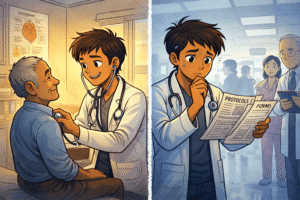
I knew the medicine. What I didn’t know was how the system expected me to practice that medicine. Adapting to a new healthcare system abroad takes far longer than most international medical graduates anticipate.
This mismatch often leads to hesitation, overthinking, and mental fatigue—especially during the first few months.
Treating Communication as a Secondary Skill
Another major mistake was underestimating how central communication is when working as a doctor overseas.
Language proficiency is only part of the problem. Tone, pacing, confidence, and cultural expectations matter just as much. Many international doctors struggle not because they lack knowledge, but because they hesitate, soften statements excessively, or delay escalation.
In systems with strong medico-legal cultures, documentation and communication are not optional extras—they are core safety skills. The mistake is realizing this too late.
Professional standards bodies consistently emphasize this. For example, the UK General Medical Council outlines communication and documentation as fundamental duties of doctors in Good Medical Practice.
Believing More Shifts Meant Faster Growth
Many international doctors fall into the same trap: saying yes to everything.
Extra shifts. Extra nights. Extra responsibilities.
This is one of the most damaging mistakes doctors make abroad. The logic feels sound—more exposure equals more learning. In reality, chronic fatigue reduces learning efficiency, worsens decision-making, and accelerates burnout.
Burnout among doctors working overseas is well documented. A review published in The BMJ highlights how excessive workload and lack of recovery time contribute to early burnout in healthcare professionals.
Working harder does not compensate for poor recovery. That was a mistake I learned the hard way.
Thinking Emotional Strain Meant Weakness
One of the most overlooked mistakes in the first year abroad is dismissing emotional stress as personal weakness.
Starting over professionally is psychologically expensive. You lose familiarity, reputation, and automatic confidence. Even simple tasks require conscious effort. Many doctors experience imposter syndrome during this phase, especially international medical graduates.
Global workforce migration reports from the World Health Organization highlight that migrant healthcare workers face increased stress during early adaptation periods due to cultural and professional adjustment demands.
Ignoring this emotional load doesn’t make it disappear—it compounds it.

Using the Wrong Benchmark
Comparison is unavoidable, but using the wrong benchmark is a critical mistake.
Local graduates are optimized for the system you are still learning. They know the shortcuts, expectations, and informal rules. Comparing your performance to theirs during your first year abroad is intellectually unfair and emotionally corrosive.
This mistake leads many international doctors to underestimate their actual progress and overestimate their deficiencies.
Waiting Too Long to Ask for Help
Fear of appearing incompetent drives another common mistake: delayed escalation.
In most developed healthcare systems, asking early is considered safe practice, not weakness. However, many doctors trained in resource-limited settings are conditioned to manage independently.
This mismatch leads to delayed decisions, unnecessary stress, and increased risk. Learning when and how to escalate is a skill—and delaying that learning is a mistake.
Putting Life on Hold “Until I Settle”
Many doctors abroad postpone fitness, relationships, hobbies, and routines, assuming stability will come later.
This is a subtle but costly mistake.
There is no clear point where everything suddenly feels settled. Without deliberate effort, survival mode becomes the norm. Over time, this erodes resilience and increases dissatisfaction—even if work performance improves.

Believing Difficulty Meant I Was Failing
Perhaps the most damaging mistake of all was interpreting struggle as evidence of inadequacy.
Struggle during the first year abroad is not a signal of failure. It is a predictable phase of adaptation. Unfortunately, many doctors internalize this discomfort instead of contextualizing it.
Recognizing that adaptation has a psychological curve—not a linear trajectory—would have saved months of unnecessary self-criticism.
Mistakes I Would Avoid If I Started Again
If I were starting my medical career abroad again, I would avoid these mistakes deliberately:
-
Prioritize system learning over speed
-
Ask questions earlier and more often
-
Protect sleep and health from the beginning
-
Accept emotional difficulty as part of transition
-
Build a life outside work immediately
These adjustments do not eliminate difficulty—but they shorten the recovery curve.
Conclusion
The first year abroad as a doctor is not just a professional transition—it is an identity reset. Most mistakes made during this period are invisible, unspoken, and only obvious in hindsight.
This article exists to make those mistakes visible earlier.
If you are struggling in your first year abroad, it does not mean you chose the wrong path or lack ability. It means you are adapting. And adaptation, while uncomfortable, is temporary—if you learn from the right mistakes.