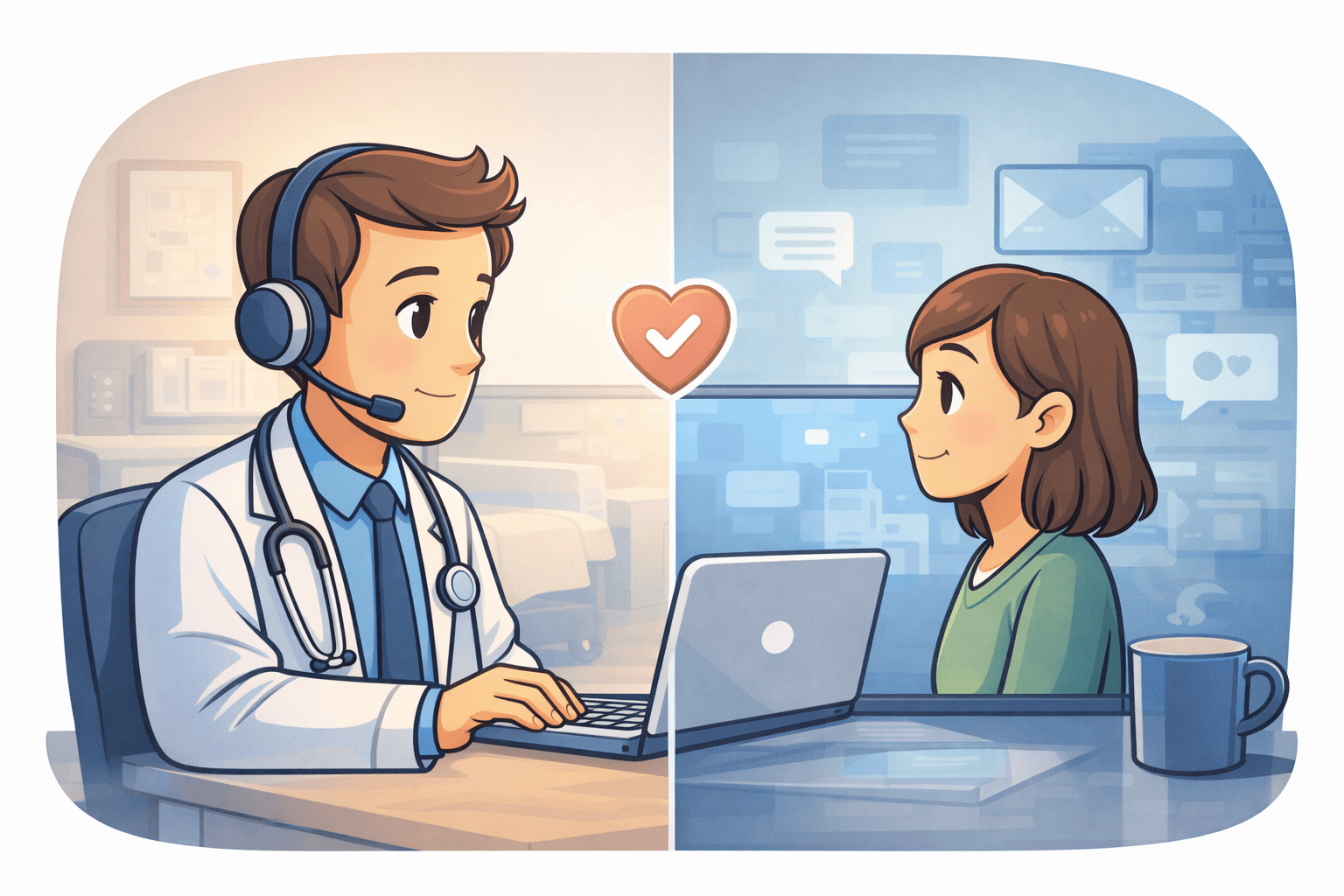
Telemedicine is no longer an experiment. It is a permanent layer of modern healthcare. What began as a necessity during global disruption quickly evolved into a mainstream model of remote patient care, reshaping virtual consultations, digital health workflows, and even physician identity.
But beneath the surface of convenience and efficiency lies a more important question:
Has telemedicine changed the doctor–patient relationship—or only the format of interaction?
As virtual care becomes routine, doctors are navigating a shift in communication style, patient engagement, and professional expectations. Yet some foundations of medicine appear surprisingly untouched.
This article examines what telemedicine truly changed—and what it did not.
The Rapid Expansion of Telemedicine in Modern Healthcare
Telemedicine did not grow gradually. It accelerated.
According to the Centers for Disease Control and Prevention (CDC), telehealth usage increased dramatically during the COVID-19 pandemic, with significant sustained adoption afterward.
Similarly, the World Health Organization (WHO) has acknowledged digital health, including telemedicine, as a strategic pillar in expanding global healthcare access.
The reasons were clear:
-
Reduced infection risk
-
Increased accessibility
-
Convenience for patients
-
Operational flexibility for healthcare systems
Telemedicine proved that care could happen beyond clinic walls. But speed of adoption does not automatically mean relational depth.
What Telemedicine Changed in Doctor–Patient Relationships

1. Telemedicine Changed the Structure of Communication
In traditional in-person consultations, communication includes ritual:
-
Greeting in the waiting room
-
Physical movement into the clinic
-
Subtle body language cues
Telemedicine compresses this.
Virtual consultations tend to be more structured, more focused, and often shorter. Small talk decreases. Transitional moments disappear. The interaction becomes efficient—but sometimes mechanical.
Doctors often report that telemedicine encourages direct questioning and concise answers. That improves time management but may reduce relational warmth.
2. Telemedicine Removed the Physical Examination Element
One of the most significant changes in telemedicine is the absence of hands-on assessment.
No palpation.
No auscultation.
No subtle physical findings that build clinical intuition.
This increases reliance on:
-
Patient history
-
Self-reported vitals
-
Visual observation through a screen
Diagnostic uncertainty naturally rises. In some cases, this leads to increased investigations or more conservative management.
A study published in JAMA Network Open discussed both the benefits and limitations of telehealth, particularly concerning diagnostic accuracy and care quality.
Telemedicine changed the mechanics of assessment—but not the responsibility of clinical judgment.
3. Telemedicine Shifted Patient Expectations
Telemedicine has subtly altered power dynamics.
Patients now:
-
Expect rapid access
-
Compare services easily
-
View healthcare more as a consumer experience
Virtual care platforms often operate on convenience models. That can improve patient engagement—but it can also increase pressure on physicians to deliver quick solutions.
The doctor–patient relationship risks becoming transactional if boundaries are not maintained.
4. Telemedicine Increased Efficiency but Introduced Screen Fatigue
Efficiency is one of telemedicine’s strongest advantages.
-
Reduced travel time
-
Faster appointment turnover
-
Greater scheduling flexibility
However, back-to-back virtual consultations introduce a different kind of exhaustion. Screen fatigue is cognitive rather than physical. There is no physical transition between patients.
This affects:
-
Emotional processing
-
Attention span
-
Empathy endurance
Telemedicine did not eliminate burnout. It reshaped it.
What Telemedicine Did NOT Change in Doctor–Patient Relationships
1. Telemedicine Did Not Eliminate the Need for Trust
Trust remains central.
Patients still evaluate:
-
Clinical competence
-
Clarity of explanation
-
Transparency about uncertainty
Whether in a clinic or on a screen, trust develops through communication quality—not proximity.
Telemedicine may change physical presence, but it does not replace the psychological contract between doctor and patient.
2. Telemedicine Did Not Remove the Importance of Listening
Patients still want to feel heard.
Active listening remains essential:
-
Allow pauses
-
Acknowledge emotions
-
Clarify concerns
Research consistently shows that communication quality strongly predicts patient satisfaction in both in-person and telehealth settings.
Telemedicine requires more intentional listening—not less.
3. Telemedicine Did Not Replace Clinical Judgment
Technology assists. It does not think.
Telemedicine platforms provide convenience and documentation tools, but diagnostic reasoning still depends on physician expertise.
Remote patient care demands:
-
Careful history-taking
-
Risk stratification
-
Appropriate escalation to in-person review
Telemedicine changed the setting. It did not change the intellectual responsibility of medicine.
Telemedicine and the Psychological Shift in Physicians
Beyond logistics, telemedicine affects professional identity.
Some physicians describe feeling:
-
More like service providers
-
Less physically connected to healing
-
Emotionally detached after long virtual sessions
The absence of physical presence can reduce perceived impact. Yet, others report improved work-life balance and increased flexibility.
Telemedicine introduces duality:
It offers freedom—but risks disconnection.
Is Telemedicine Weakening Doctor–Patient Relationships?
Arguments suggesting telemedicine weakens relationships include:
-
Reduced physical intimacy
-
Fewer non-verbal cues
-
Potential fragmentation of care
Arguments suggesting telemedicine strengthens relationships include:
-
Increased accessibility
-
More frequent follow-ups
-
Lower barriers for vulnerable populations
The reality is nuanced.
Telemedicine can weaken relationships if used purely for efficiency.
It can strengthen them if used thoughtfully within a hybrid care model.
How to Strengthen Doctor–Patient Relationships in Telemedicine Practice
Doctors can intentionally improve relational depth in virtual care:
-
Maintain eye-level camera positioning
-
Pause before responding
-
Verbally acknowledge emotions
-
Clearly explain diagnostic uncertainty
-
Arrange structured follow-ups
Building rapport in telemedicine requires conscious effort. Small communication adjustments significantly influence patient trust.
The Future of Telemedicine: Hybrid, Not Replacement
Telemedicine is not replacing traditional care. It is integrating into it.
Optimal models include:
-
Telemedicine for follow-ups and chronic disease management
-
In-person care for complex, procedural, or high-risk cases
Healthcare systems worldwide are moving toward blended digital health frameworks rather than full virtual substitution.
Telemedicine changed access.
It changed speed.
It changed format.
It did not change the human need for trust, competence, and empathy.
Conclusion: Telemedicine Changed the Medium, Not the Core
Telemedicine transformed how doctors and patients meet. It altered communication structure, removed physical examination, increased efficiency, and shifted expectations.
But the core of medicine remains unchanged:
-
Patients want to feel heard.
-
Doctors remain responsible for sound judgment.
-
Trust still determines the strength of the relationship.
Telemedicine is a tool. The doctor–patient relationship is human.
Technology evolves. The need for connection does not.
Related Reading :
- How Telemedicine Is Changing the Doctor–Patient Relationship
- Will AI Replace Doctors? My Honest Opinion From the Frontline
- Why Some Patients Teach You More Than Any Medical Textbook





1 comment
Thanks