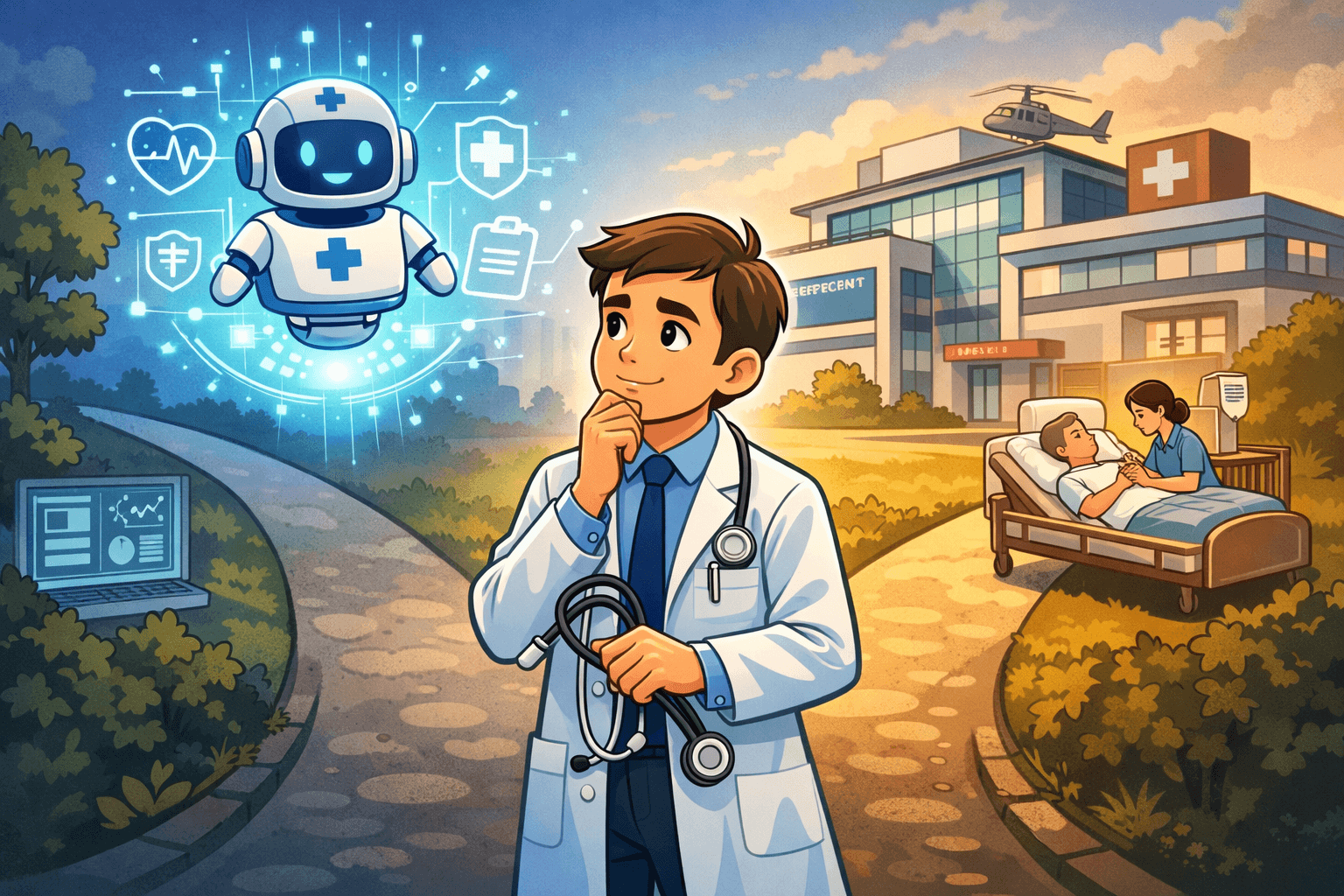

Why AI Has Every Doctor Talking
AI is no longer a futuristic concept in medicine — it is already here. From AI-assisted diagnosis to automated medical documentation, artificial intelligence in medicine is quietly becoming part of daily clinical practice. As a doctor working on the frontline, I hear the same question repeatedly from colleagues and medical students alike: Will AI replace doctors?
This fear is understandable. Headlines suggest that AI can diagnose diseases, read scans faster than humans, and even outperform doctors in certain tasks. But the reality of AI in healthcare looks very different when you are standing beside a patient at 3 a.m., making decisions with limited information, emotions running high, and lives at stake.
So let’s talk honestly — without hype, without fear-mongering — about whether AI will replace doctors, and what the future of doctors in the AI era truly looks like.
Why Doctors Are Worried About AI Replacing Them
The anxiety around AI replacing doctors is real, and it is growing.
Medical professionals are facing:
-
Rapid expansion of AI in healthcare systems
-
Lack of clear guidance on how AI will affect medical jobs
-
Sensational media claims about “AI doctors”
-
Minimal formal training on AI in medicine
For many clinicians, AI feels like something happening to them, not something they control. This uncertainty fuels fear — especially among junior doctors and medical students who wonder if their careers will still exist in 10 or 20 years.
What AI Can Already Do in Modern Medicine
Before dismissing the fear, we need to acknowledge the truth: AI in medicine is powerful.
AI in Medical Diagnostics
AI excels at pattern recognition. In radiology, dermatology, and pathology, AI systems can detect abnormalities faster and sometimes more consistently than humans. Studies published in Nature Medicine show AI matching specialist-level performance in imaging tasks.
But detecting a pattern is not the same as understanding a patient.
AI in Clinical Documentation and Admin Work
AI is increasingly used to:
-
Generate medical notes
-
Summarize patient histories
-
Assist with referrals and discharge letters
This is where AI can genuinely reduce doctor burnout — by removing administrative overload rather than replacing clinicians.
AI in Clinical Decision Support
AI tools can suggest diagnoses, risk scores, or treatment options. However, they rely entirely on data quality and predefined algorithms. They do not take responsibility for decisions — doctors still do.
What AI Cannot Replace in Doctors
Despite its strengths, AI has fundamental limitations.
AI vs Human Clinical Judgment
Medicine is full of uncertainty. Patients rarely present exactly like textbooks describe. AI struggles when:
-
Symptoms are atypical
-
Data is incomplete
-
Resources are limited
-
Context matters more than numbers
Frontline medicine requires intuition, experience, and adaptability — qualities AI does not possess.
AI Cannot Replace Empathy and Trust
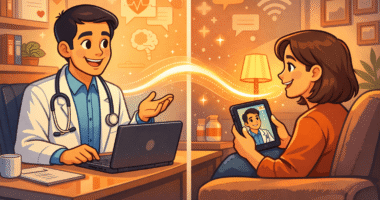
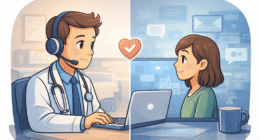
Patients do not come to doctors only for diagnoses. They come for reassurance, understanding, and human connection. Breaking bad news, addressing fear, and navigating cultural beliefs are areas where AI simply cannot replace doctors.
AI and Legal Responsibility in Healthcare
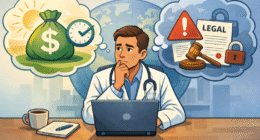
When AI makes a suggestion that leads to harm, who is responsible? Currently, the doctor remains legally accountable. Until AI can assume ethical and legal responsibility — which it cannot — doctors remain central to care.
The World Health Organization has repeatedly emphasized that AI should support, not replace, healthcare professionals.
Will AI Replace Doctors in the Future?
The Honest Answer? No — but AI will replace doctors who refuse to adapt.
AI is not here to eliminate doctors. It is here to change how doctors work. The stethoscope didn’t replace doctors. Imaging didn’t replace doctors. Electronic health records didn’t replace doctors. AI is another tool — powerful, yes — but still a tool.
Doctors who understand AI will thrive. Doctors who ignore it may struggle.
Which Medical Specialties Are Most Affected by AI
AI in Radiology and Pathology
Radiology and pathology often top lists of specialties “at risk.” In reality, AI increases efficiency and workload capacity rather than eliminating specialists. Human oversight remains essential.
AI in Emergency Medicine
In emergency medicine, AI can assist with triage and risk stratification, but it cannot manage chaos, uncertainty, and rapid decision-making under pressure.
AI in General Practice and Internal Medicine
AI can help screen, monitor, and flag issues — but comprehensive patient care, continuity, and complex decision-making still rely on doctors.
The U.S. FDA clearly categorizes AI tools as medical devices, not replacements for clinicians.
How Doctors Can Future-Proof Their Careers in the AI Era
Instead of asking whether AI will replace doctors, a better question is: How can doctors work with AI?
Key strategies include:
-
Understanding AI strengths and limitations
-
Strengthening clinical reasoning skills
-
Developing communication and leadership abilities
-
Using AI as decision support, not decision authority
Doctors who combine medical expertise with AI literacy will be more valuable than ever.
Should Medical Students Worry About AI Replacing Doctors?
This is one of the most searched questions online — and the answer is reassuring.
Medicine is still worth pursuing. AI is changing healthcare, but it is also increasing demand for skilled clinicians who can interpret, contextualize, and humanize care.
If anything, future doctors will need more judgment, not less.
My Honest Opinion on AI From the Frontline
From the bedside, AI does not look like a replacement. It looks like a helper — sometimes useful, sometimes flawed, often impressive, but never human.
Patients do not ask AI to hold their hand.
They ask doctors.
AI will reshape medicine. But doctors will remain at the center of it.
AI Will Change Medicine — Not Replace Doctors
AI in healthcare is inevitable. Fear is understandable, but replacement is unlikely. The future of doctors is not about competing with AI — it is about learning how to use it wisely.
The real risk is not AI replacing doctors.
The real risk is doctors refusing to evolve.